
📝 Disclaimer: The content on this site is for informational and educational purposes only and does not constitute professional electrical, engineering, or technical advice. Always exercise caution, follow manufacturer guidelines, and consult a certified technician before attempting any hardware repairs, modifications, or installations.
* This post may contain affiliate links. As an Amazon Associate, we earn from qualifying purchases at no extra cost to you.
* This site uses AI technology for content assistance and illustrative imagery. Images are for demonstration purposes and do not depict real people or events.
Understanding Edge Computing
Edge computing is an architectural approach in which some data processing, application logic, or content delivery takes place closer to the systems generating or requesting the data. Instead of sending every operation to a distant centralized data center, an edge arrangement places selected computing functions at distributed locations such as network facilities, local data centers, or specialized edge nodes.
The term describes a distribution model rather than one specific hosting plan or hardware configuration. Edge infrastructure can include physical servers, virtual machines, containers, caching systems, and network services operating near users, devices, or branch locations.
Structural Logic of the Architecture
Traditional centralized hosting commonly concentrates applications and data in one primary facility or a limited group of regions. Edge computing introduces additional processing locations around that central environment. These locations may handle selected workloads while the central infrastructure retains broader application, storage, or coordination responsibilities.
The division of functions varies by architecture. An edge node may deliver cached content, process sensor data, perform request routing, or execute a small application component. More data-intensive or centralized operations can remain in a core data center or cloud environment. This creates a distributed relationship between edge locations and central infrastructure rather than replacing the central environment entirely.
Network proximity is a major classification factor. A geographically or topologically closer processing point can reduce the distance that certain requests travel, although actual network behavior depends on routing, congestion, workload design, and facility placement. Edge computing therefore describes location and distribution characteristics, not an unconditional performance result.
Common Infrastructure Contexts
Edge computing appears in content delivery networks, industrial monitoring, connected devices, telecommunications infrastructure, retail systems, and geographically distributed applications. In web hosting, edge locations may be associated with cached assets, request routing, application execution, or localized data processing.
The architecture also intersects with virtualization and containerization. Virtual machines or containers can package application functions for operation across multiple edge nodes, while orchestration systems may coordinate their placement and lifecycle. These components introduce operational considerations involving synchronization, observability, software distribution, and data consistency.
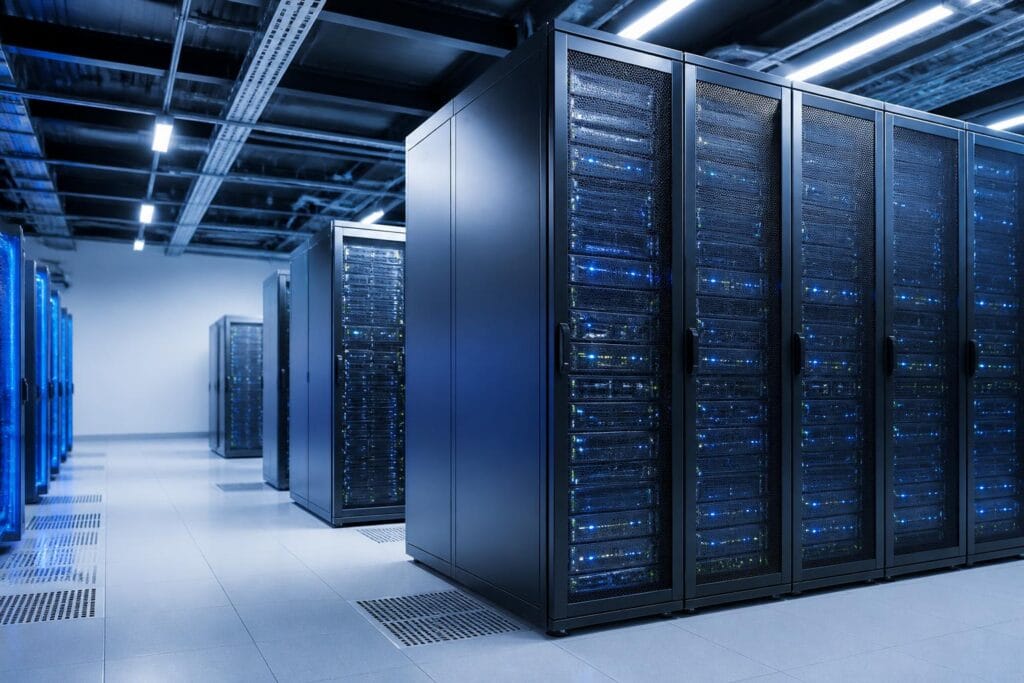
Data center design remains relevant. Edge facilities may be smaller and more distributed than conventional hyperscale or regional data centers, with different arrangements for power, cooling, physical access, connectivity, and maintenance. Their classification depends on the infrastructure model and service architecture rather than the word “edge” alone.
Operational Characteristics to Observe
- Distributed processing: Workloads are divided across central and geographically dispersed computing locations.
- Network proximity: Certain requests or data flows are handled nearer to their originating devices or users.
- Central coordination: Core systems may continue to manage shared data, policies, application state, or long-term storage.
- Workload partitioning: Different application functions can operate at the edge, in regional facilities, or in a central environment.
- Container and virtual machine support: Packaged software units may be used to represent portable processing functions across locations.
- Data consistency: Multiple processing sites can introduce architectural considerations around synchronization and state management.
- Facility variation: Edge nodes may differ in physical capacity, connectivity, power design, and operational access.
- Availability model: Resilience characteristics depend on the number, independence, and coordination of participating locations.
Edge Computing Within Hosting Classification
Edge computing is best understood as an infrastructure and deployment architecture rather than a standalone category alongside shared hosting, VPS hosting, or dedicated servers. An edge-based service can use several underlying resource models, including dedicated hardware, virtualized environments, containers, or managed application platforms.
Its defining feature is the placement of computing functions across distributed network locations. The resulting environment may combine centralized hosting with regional or local processing, creating a layered structure across core data centers, network facilities, and endpoint-adjacent systems. No single edge arrangement establishes universal speed, availability, or security characteristics; those properties depend on the architecture, operations, and service conditions surrounding it.